Direct link to add specific google calendar event?

Direct link to add specific google calendar event

https://calendar.google.com/calendar/render?action=TEMPLATE&pli=1&sf=true&output=xml& text=[Event_Title]& details=[Event_Details]&location=[Event_Location]& dates=[From_Date_Time]/[To_Date_time]

for e.g

https://calendar.google.com/calendar/render?action=TEMPLATE&pli=1&sf=true&output=xml&text=Sample Event&details=Sample Events Details &location=Location&dates=20151208T180000Z/20151208T191500Z

Dates are given YYYYMMDDTHHMMSSZ format, use GMT time, google automatically convert into your calendar default one
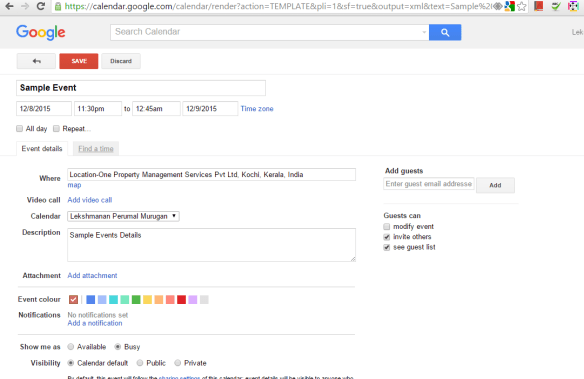
 

google-add-events-link

Spring inject value into a static field

using org.springframework.beans.factory.config.MethodInvokingFactoryBean to invoke a static setter.

e.g
public Class ClassName{
private static Object fieldName;
public static void setFieldName(final Object fieldName)
{
ClassName.fieldName = fieldName;
}
}

Spring Injection:

<bean class="org.springframework.beans.factory.config.MethodInvokingFactoryBean">
<property name="staticMethod" value="package.ClassName.setFieldName" />
<property name="arguments">
<list>
<ref bean="refObject" />
</list>
</property>
</bean>

Ref:

delete multiple files and files in windows using command prompt in less time

Take too much to delete too many files folder in window explorer.

Using following simple steps to delete files using command prompt with less time

use rmdir to delete the files and subfolder,

rmdir /s/q MyFolderPath
However, it is significantly faster, especially when you have a lot of subfolders in your structure to use del before the rmdir, like this:

del /f/s/q MyFolderPath > nul
rmdir /s/q MyFolderPath

First Message transmitted over the Internet – “LO”

In internet world, people transmitting billions bytes data. But do you know what word transmitted over the internet

The transmission itself was simply to “login” to SRI from UCLA. They succeeded in transmitting the “l” and the “o” and then the system crashed! Hence, the first message on the Internet was “lo”, as in “lo and behold! They were able to do the full login about an hour later.

Src: http://www.lk.cs.ucla.edu/internet_first_words.html