Unknown's avatar

About Lekshmana Perumal Murugan

Engineer | Educator | Mentor | From Rural Roots to Global Tech | Building People & Platforms | Learning, Teaching & Growing—Together I’m Lekshmana Perumal—Engineer, Educator, and Builder of People & Platforms. My personal mantra: if you grow, grow others with you. I don’t just build code—I build trust, systems, and people. 📌 Personal Vision: To grow—and help others grow—through technology, mentorship, and honest reflection. To lead with kindness, stay curious, and leave behind something that matters. Let’s connect if you value mentorship, clarity, and long-term impact.

Punishment vs Understanding: A Parent’s Dilemma

(Honest thoughts on raising kids with heart and clarity)

Parenting doesn’t come with perfect documentation — and certainly not with a bug-free implementation.
There’s no one-line method called raise_child(empathetic, confident).

Instead, it’s a constant try…catch.


“Sometimes, I punish him.”

Yes, I do.
Not out of anger, but instinct. Maybe tiredness. Maybe frustration.
And sometimes… because I truly didn’t know what else to do in the moment.

But here’s the part that matters:

After that, I sit with him. I ask why he did it.
I explain why it wasn’t okay.
I don’t just raise my voice. I lower myself to his level.

It’s not about control. It’s about connection.


Kids don’t listen to lectures. They observe humans.

If I mess up, I try to own it.
He watches that.
If I lose my temper, I circle back and talk about it.
He watches that too.

My kid is not a “good boy” just because he follows what I say.
I want him to question. To know why.
Not because I told him, but because he understood it.


So which is right? Punishment or understanding?

Let me be honest.
Both exist. But one should lead the other.

Punishment, when needed, must come from a place of clarity.
Not as a shortcut to obedience, but as a path to realization.
Understanding always follows — and sometimes, should even replace it altogether.

Because understanding creates awareness.
And awareness is the real discipline.


But hey, we’re human.

We slip.
Sometimes we punish before we pause.
Sometimes we shout before we understand.

But if you sit down later, look into those small eyes, and say:

“Appa also makes mistakes. Let’s both try again tomorrow.”
That child learns the most valuable lesson we can teach:
Grace.


Parenting isn’t about being perfect. It’s about being present.

There’s no algorithm for raising a child with heart.
But there’s always space for small updates.
Some patches take time to apply. Some fixes run deep.

But never forget —
Kids don’t grow on commands.
They grow when they feel safe, seen, and supported.

And that… takes understanding.
Even when we start with punishment.


If this resonates, pass it on. Not as advice. But as reflection.

We’re all building our versions of parenthood.
Brick by brick. Word by word.
Mistake by mistake.
With love at the core.

LekshmanaIn


👨‍👩‍👧 பெற்றோராக இருப்பது – தண்டனையா? புரிதலா?

Friends,
சில நேரம்
குழந்தையை அடிச்சுட்டு
அதுக்கப்புறம்
மனசு கனமாகி,
“இது சரியா?”
ன்னு நம்மையே கேட்குற தருணம்
நிறைய பேருக்கு இருக்கும்.

அது எப்போதும்
கோபத்தால மட்டும் நடக்கறது இல்லை.
சில நேரம்
சோர்வு,
வேலை அழுத்தம்,
என்ன செய்யணும்னு தெரியாம,
அந்த நிமிஷத்துல
வந்த ஒரு தவறான முடிவு.

நானும் அப்படித்தான்.
சில சமயம்
குழந்தைக்கு தண்டனை கொடுத்திருக்கேன்.
அது
கோபத்துக்காக இல்லை.
அந்த நேரத்துல
வேற வழி தெரியாம.

ஆனா அதுக்கப்புறம்
நான் அவன்கிட்ட உட்காருவேன்.
“ஏன் அப்படி செய்த?”
“அது ஏன் சரியில்லை?”
ன்னு அமைதியா பேசுவேன்.
கத்துறதை விட,
அவன் உயரத்துக்கு
நானே இறங்கி பேச முயற்சி செய்வேன்.

அப்போதான் புரிஞ்சது —
இது
அடக்கி ஆளுற விஷயம் இல்லை.
ஒரு உறவு பற்றிய விஷயம்.

குழந்தைகள்
நம்ம சொற்பொழிவை
அவ்வளவா கேட்க மாட்டாங்க.
ஆனா
நம்ம நடத்தையை
கவனிப்பாங்க.

நான் தவறு செய்தா
அதை ஒத்துக்கிட்டா,
அவனுக்கு அது தெரியும்.
நான் கோபம் இழந்துட்டு,
பிறகு திரும்ப வந்து பேசினா,
அதையும் அவன் பார்க்குறான்.

என் குழந்தை
நான் சொன்னதால மட்டும்
“நல்ல குழந்தை” ஆகணும்னு
நான் நினைக்கல.
அவன்
கேள்வி கேட்கணும்.
ஏன் சரி?
ஏன் தவறு? ன்னு புரிஞ்சுக்கணும்.
பயத்தால இல்ல —புரிதலால.

அப்படின்னா
எது சரி?
தண்டனையா? புரிதலா?

உண்மை என்னன்னா —
இரண்டுமே வாழ்க்கையில இருக்கும்.
ஆனா
தண்டனை வந்தா,
அதுக்கு பின்
புரிதல் வரணும்.

தண்டனை
சும்மா
கட்டுப்படுத்துவதற்காக
இருக்கக்கூடாது.
அது
புரிய வைக்குற வழியா
இருக்கணும்.

பல நேரம்
புரிதலே
தண்டனையை விட
பலமாக வேலை செய்யும்.

ஏன்னா
ஒரு விஷயத்தை
புரிஞ்சுக்கிட்ட குழந்தை,
அதை மறக்காது.
அது தான்
உண்மையான ஒழுக்கம்.

நம்ம எல்லாருமே மனிதர்கள்.
சில நேரம்
யோசிக்காம
நடந்து விடுவோம்.
புரிய வைக்குறதுக்கு முன்னாடி
கத்தி விடுவோம்.

ஆனா
பிறகு
அந்த குழந்தையைப் பார்த்து,
“அப்பாவும் / அம்மாவும்
சில நேரம் தவறு செய்றோம்.
நாளைக்கு
இருவரும்
மீண்டும் நல்லா முயற்சி பண்ணலாம்” ன்னு சொன்னா —
அந்த ஒரு உரையாடல்
அவனுக்கு
ஒரு பெரிய பாடமாகும்.

பெற்றோராக இருப்பது
perfect ஆக இருப்பது இல்லை.
இருப்பது தான் முக்கியம்.

குழந்தைகள்
கட்டளையால வளர மாட்டாங்க.
அவங்க
பாதுகாப்பா இருக்குனு உணர்ந்தா,
நம்ம கவனம் அவர்கள்மேல இருக்குன்னு உணர்ந்தா,
அன்போட
வழிகாட்டல் கிடைத்தா —
அப்போதான்
அவர்கள் நல்லா வளருவாங்க.

அதுக்காக
நமக்கு
புரிதல் தேவை.
சில நேரம்
நாம் தண்டனையிலிருந்து
தொடங்கினாலும் கூட.

-lekshmana ❤️

The Shoulder Legacy

Some mornings, I carry my son on my shoulder to his van.
He doesn’t ask why — it’s just part of our rhythm.
But in the evening, when his grandfather picks him up, he walks back home on his own.

No complaints. No “Appa carried me, you should too.”

I watched that. And something inside me paused.

Maybe — just maybe —
He already knows.

That his grandfather once carried me on those same roads.
That those shoulders once bore the weight of a boy with dreams, doubts, and school bags twice his size.
That those shoulders carried the legacy, not just the load.

So now, my son walks beside him.
Like saying: “You’ve carried enough. Now, I’ll walk.”

That moment didn’t need words.
It was a quiet relay — one generation handing over strength,
the next carrying respect,
and a child learning both.


Why share this?

Because in the rush of routines and responsibilities,
we sometimes forget —
What we carry matters.
But what we choose not to — also tells a story.

And every small act, even a walk home,
can reflect a lifetime of love,
and the invisible strength passed down without speeches.

This is my note to the future:
Respect is not just taught — it’s felt.
Legacy isn’t built — it’s lived.


👣 ஒரு மாலை நேரக் கவனம்

தினமும் காலையில
என் மகனை
நான் தூக்கி பள்ளி
வண்டி வரைக்கும் கொண்டு போவேன்.

அவன் அதைப்பற்றி
ஒன்னும் கேக்க மாட்டான்.
அது நம்ம routine-ல
ஒரு பகுதி மாதிரி தான்.

மாலை நேரம்
அவன் தாத்தா அவனை கூட்டிட்டு வரும்போது,
அவன் நடந்து தான் வீட்டுக்கு வருவான்.

“அப்பா தூக்கினாரே,
நீங்களும் தூக்கணும்”னு அவன் சொல்லல.

அந்தக் காட்சியை பார்த்தப்போ
எனக்குள்ள
ஒன்று நினைவுக்கு வந்தது.

அவன் சொல்லாமலே
ஏதோ புரிஞ்சுக்கிட்ட மாதிரி தோணிச்சு.

ஒரு காலத்துல
அதே வழில
அவனோட தாத்தா
என்னையும்
இதே தோள்ல தூக்கிட்டு நடந்திருக்காரு.

பள்ளிப்பை,
கனவுகள்,
பயங்கள் —
எல்லாத்தையும் சேர்த்து.

அந்த தோள்கள்
சுமைய மட்டும் இல்ல,
ஒரு பொறுப்பையும்
சுமந்திருக்குது.

இப்போ
அவன் அவங்க பக்கத்துல
நடந்து வர்றான்.

“நீங்க போதுமான அளவுக்கு தூக்கிட்டீங்க.
இப்போ நான் நடக்குறேன்”னு
சொல்லாமலே சொல்லுற மாதிரி.

அந்த நிமிஷத்துக்கு
வார்த்தை தேவையில்லை.

அது
ஒரு தலைமுறையிலிருந்து
அடுத்த தலைமுறைக்கு
அமைதியா செல்கிற
ஒரு புரிதல்.

நான் இதை ஏன் எழுதுறேன்னா —

நம்ம தினசரி வேலைகளில்
அவசரங்களில்
கவனிக்காம போகும்
சின்ன விஷயங்கள்தான்
பெரிய அர்த்தம் கொண்டிருக்கும்.

நாம் என்ன பன்றோம் என்பதையும்,
எதை பன்னாம விட்டோம் என்பதையும்
வாழ்க்கை கவனிக்குது.

மரியாதை
சொல்லிக் கொடுக்கப்படுறது மட்டும் இல்ல.
அது உணரப்படுறது.

பாரம்பரியம்
கட்டப்படுறது இல்ல.
அது நடந்து காட்டப்படுறது.

— LP

📖 Story 17 – Mukshi and the Man with the Rope

Mukshi and the Man with the Rope

🏡 Banana. Water. No Hurry.

“Banana. Water. No hurry today,” Amma said, tying Mukshi’s bag.

She was peeling drumsticks slowly. One by one. Her eyes were soft today. Not sleepy. Just soft.

Mukshi tied his shoes slowly.

Daksh blinked from the window.

That meant: “Time to go.”


🚲 A Quiet Ride

The forest road felt slow.
Not sleepy. Just thinking.

The trees didn’t wave. The birds didn’t call.

Only the sound of tires on dust.

Then Mukshi heard something new—
A voice. Steady. Talking to no one.


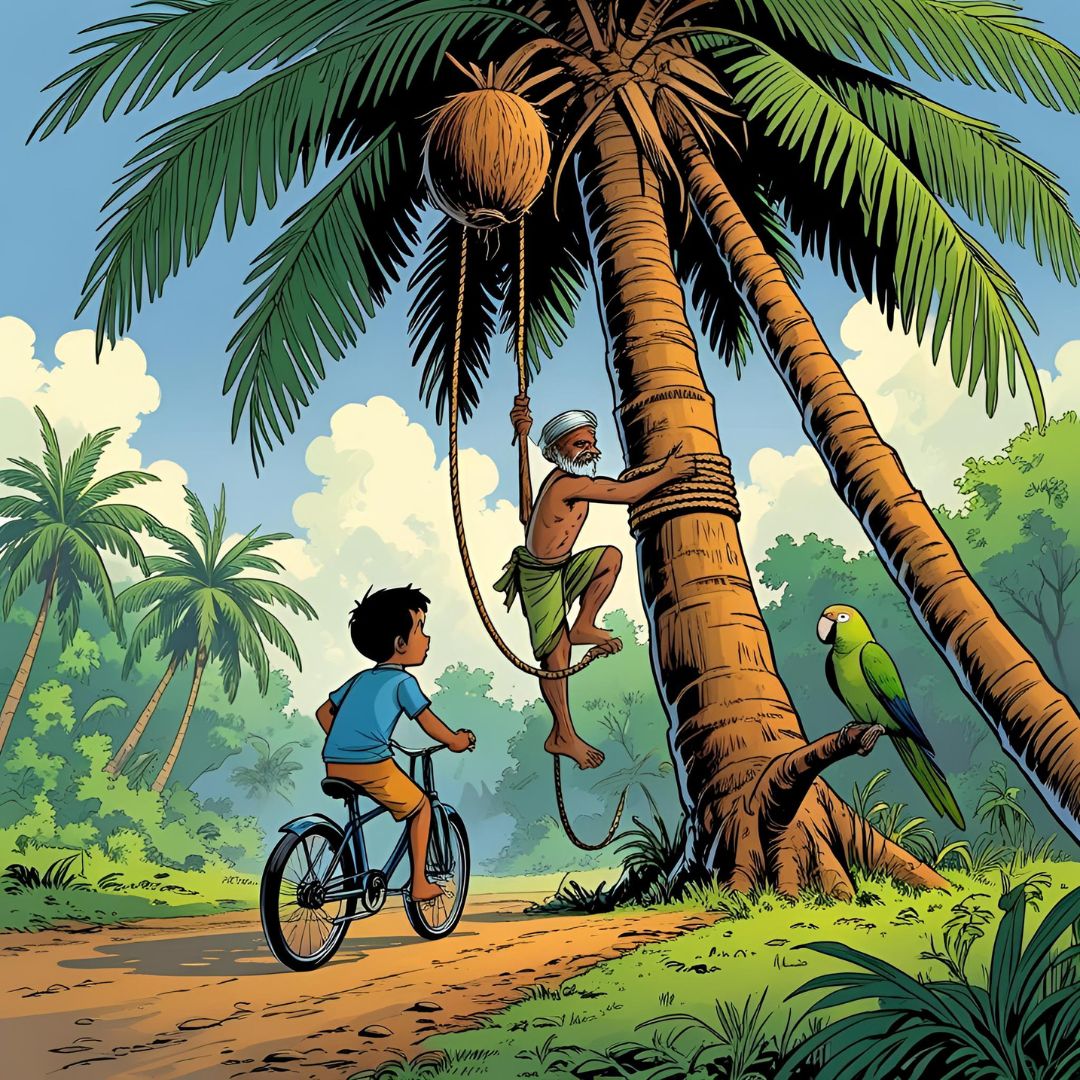
🥥 The Man with the Rope

He was wrapping a long brown rope around his arm.

A coconut tree stood behind him, tall and patient.

“You climb trees?” Mukshi asked.

The man nodded. “But not for fun. For work.”

He held the rope up.

“This helps me go up. And come down without breaking something I still need.”
(He tapped his leg.)

Mukshi smiled.


🧑🏽‍🌾 The Climb

He tied the rope, hugged the tree, and rose like he belonged there.

A coconut fell. It rolled toward Mukshi.

“Too old to drink,” the man called. “But full of oil.”

Then a green leaf floated down.

Mukshi caught it.

“Why a leaf?” he asked.

“Because most people miss the small things.”


🧒🏽 Back on the Path

Mukshi tied the leaf to his bag string.

“Will he be there next time?” he asked Daksh.

Daksh blinked once.

“That means maybe,” Mukshi smiled.

Then softer:
“Some people feel like trees.
You only notice them when they move.”


🏡 Home Again

Amma was still in the kitchen, stirring something slowly.

“Your bag’s heavier,” she said.

“Only a leaf,” Mukshi replied.

“But your eyes are wider.”

“I saw a man float up a tree,” Mukshi added.
“Like that beetle from last month. The green one.”

Amma smiled. “Your Appa once climbed like that.”

Mukshi paused. “What happened?”

“He started watching the trees instead,” Amma said.
“Some people do.”


Not all learning comes from questions.
Sometimes it comes from watching…
and catching the leaf someone chose to drop.

📖 Story 16 – Mukshi and the Stuck Goat

Mukshi and the Stuck Goat

☀️ The Pause Before the Ride

Amma was peeling small onions.
Her eyes were wet, but not from crying.

Mukshi tied his shoelaces.
Daksh blinked from the roof’s edge.

“That means yes?”
Daksh blinked again.
“That means yes… again,” Mukshi smiled.

Amma handed the bag.
“Banana. No shortcuts through the thorny slope.”

🚲 A Goat in a Tangle

They rode past the sleeping dog rock.
Past the swing tree.

Then a sound.

“Baa-aa.”

Mukshi stopped.

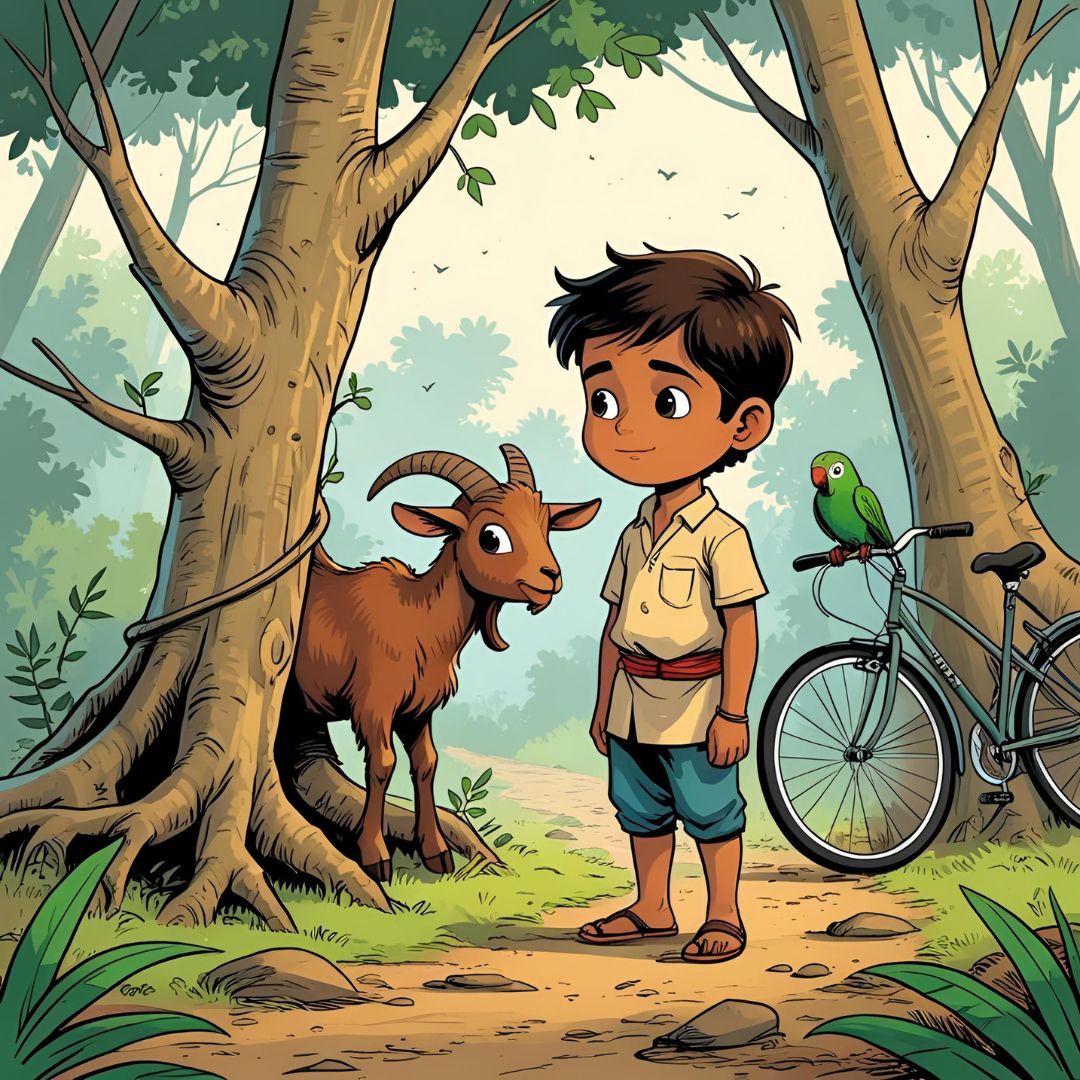
A small goat was standing between two trees.
Its rope was caught under a thick root.

It tried to move forward.
But the rope pulled it back.

“Stuck,” Mukshi said.

Daksh landed on the handlebar.
He blinked once.

🧠 A Better Way

“I’ll pull it free,” Mukshi said.

He stepped forward.
Grabbed the rope. Tugged a little.

The goat pulled too.
But nothing happened.

Daksh blinked again.
Mukshi paused.

He looked again.
Then walked behind the goat.
Untied the rope from the tree.
And let the goat walk backwards, out of the root loop.
It worked.

The goat blinked.
Shook its ears.
And walked away, quiet and proud.

🏡 The Onion and the Pause

Amma was still peeling.
The bowl was half full.

“You’re late,” she said.

“Helped someone,” Mukshi replied.
“A goat.”

She looked at him sideways.
“Did you lift it?”

“No,” Mukshi said.
“I just looked better. Then found a way.”

Amma nodded.

“Last week you gave away your banana,” she said.
“This week you gave your time.”

Then she smiled.

“You used your head before your hands.”
Daksh blinked once from the window.

“That means yes,” Mukshi said.
“And that still means yes.”

Being smart isn’t always about knowing more.
Sometimes it means…
just stopping to look again.

📖 Story 15 – Mukshi and the Honest Pocket

☀️ The Drop and the Thought

Amma was stitching something by the window.
A needle in her mouth.
She was mending an old cloth. Maybe a memory.

Mukshi tied his shoelaces slowly.

Daksh blinked from the shelf.
“That means yes?” Mukshi asked.
Daksh blinked again.
“That means yes… again,” Mukshi smiled.

Amma handed the bag.
“One banana. And tell the truth, if something asks.”


🚲 The Forest Sounds Funny Today

They passed the usual turn.
Past the broken gate and the leaning tree.

Somewhere near the big anthill, Mukshi heard it.

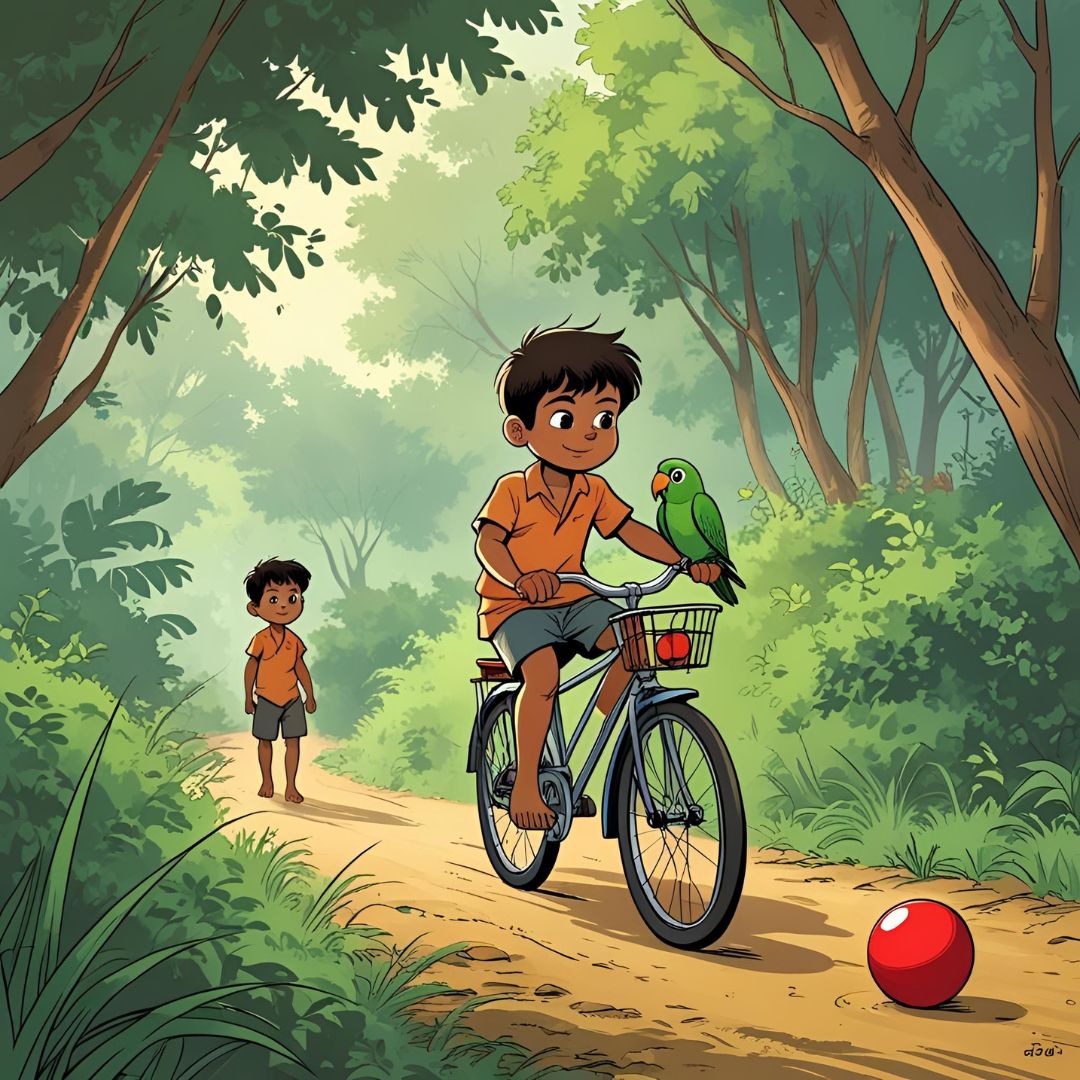
Bounce. Roll. Tap.

A small, red bouncy ball—rolling in the dust.

He stopped. Picked it up.

Daksh tilted.

“Not mine,” Mukshi said.
“But it’s nice.”


🧒 A Stranger With Small Steps

From behind the bushes, a smaller boy appeared.
Shirt half tucked. Hair sideways.

“My ball!” he said.

Mukshi looked at it in his palm.

“I didn’t take it,” he said.
“I just saw it. I picked it up.”

The boy nodded.
“Okay.”
He took the ball, looked at it like it was still moving.
Then gave a small smile.
“Thanks,” he said quietly.
And walked back the way he came.


🚲 The Ride Felt Different

No breeze. No big talks.

Just Daksh, flying slow.
And Mukshi, thinking quiet.

“I felt like keeping it,” he thought.
“But I gave it back.
I told the truth.”

And somehow,
the road didn’t feel so heavy anymore.


🏡 The Needle and the Pause

Amma was still stitching.

“You saw something today?” she asked.

Mukshi nodded.
“A ball.”

“Did you take it?”

“I felt like keeping it,” he said.
“But I gave it back.
I told him the truth.”

Amma didn’t ask more.
She stitched two more loops. Then said:

“Some things stay lighter if you carry them honest.”

Daksh blinked once from the window.

“That means yes,” Mukshi said.
“And that still means yes.”


Telling the truth doesn’t always sparkle.
But it keeps your pockets light,
And your road a little easier to ride.

📖 Story 14 – Mukshi and the Bottle in the Wind

Mukshi and the Bottle in the Wind

☀️ One Sock, One Breeze

Amma was drying socks on the line.
One flew off.

Mukshi caught it mid-air and held it like a treasure.

Daksh blinked twice from the gate.

“That means yes?”
Daksh blinked again.

“That still means yes.”

Amma handed the bag.
“One banana. Bottle’s full. Nothing extra.”


🚲 A Crinkle by the Fence

They rode past the well.
Past the dog-shaped rock.
Near the old fence—something shimmered.

A plastic bottle.
Rolling slightly. Stuck between roots.

Mukshi stopped.

“Someone left this.”

Daksh tilted.

“Not ours,” Mukshi said.
“But it’s on our road.”


🫙 The Pick-Up and the Plan

He picked it up gently—like it might be scared.
The bottle was scratched. Empty. Light.

“I could throw it far,” Mukshi said.
Daksh blinked once. That meant: “Why?”

Mukshi looked at it again.

“Maybe if I carry it,” he said,
“it won’t get left again.”

Then he tied it to the back of the cycle with a string.
“We’ll carry it. At least for now.”


🏞️ The Long Road Talks

The forest rustled.
Daksh flew quiet loops.
Mukshi pedaled.

They didn’t talk much.
The bottle bumped behind like a soft drum.

Not heavy.
Just there.


🏡 Amma and the Sock

Back home, Amma was watering the neem tree.

“You tied something new?” she asked.

Mukshi showed the bottle.

“It wasn’t ours,” he said.
“But I didn’t want it to be no one’s.”

She nodded.
“Some things… only get better if someone cares.”

Daksh landed on the handlebar. Blinked once.

“That means yes,” Mukshi said.
“And that still means yes.”


Not everything we carry is ours.
But the road is.
And what we leave behind… shows who we are.

✍️ We Don’t Just Use Slack. We Work Inside It.

✍️ We Don’t Just Use Slack. We Work Inside It.

Most teams know Slack.
But not all of them use it like we do.

This isn’t about features.
It’s about how we shaped small habits into something quietly powerful.

We didn’t overhaul anything.
We just paid attention to what slowed us down—and Slack helped fix it, piece by piece.

🔁 Reminders

For weekly tasks, monthly rituals, and process nudges.
Slack remembers—so we stay focused.

🧵 Threading

Keeps our channels from becoming noise piles.
Makes things easy to find—especially for someone catching up later.

📚 Canvas

We use it daily for:

  • KT sessions & team notes
  • Onboarding steps
  • Tech references, PR lists, tips
  • Info others usually ask for again and again

Easy to edit, easy to update.
Still synced later to Confluence when needed.

🤖 Workflows

Onboarding is smooth—people auto-join the right channels, get docs, and know where to start.
No guessing. No manual follow-up.

🔖 Bookmarks + Pins

One-click access to key links.
We no longer waste time searching past messages.

📢 Weekly Wins + Quiet Praise

Every week, a thread highlights team updates, blockers cleared, mini shoutouts.
Not flashy—just shared. And felt.

📡 Real-Time Monitoring & Visibility

Daily ops workflows share what’s happening without interruption
Monitoring status and ongoing issues are shared in public channels, so everyone stays aligned.

When cross-team coordination happens, it’s in a dedicated channel
We use Canvas to track discussions, and sync permanent outcomes to our docs

Even if someone’s offline or out, others can find the state of things instantly.

🧠 What Changed?

We stopped using Slack like a chatbox.
And started using it like the front-end of how we work.

Now:

  • Fewer repeated questions
  • Clearer context sharing
  • Stronger continuity across people and time
  • Public workflows that reduce silos

We still use Jira, Confluence, and other tools.

Slack didn’t replace anything—it just made the work visible while it was happening.

It’s not the only way.
But it’s a way that helped us think, share, and support without extra meetings.

— Lekshmana
(Not a theory. Just practice that made things smoother.)

Thanks Slack 🙏

Story 13 – The Coin in the Sand

☀️ The Morning With Sand

Amma was sweeping the veranda.
The sound was soft, like sand scratching a drum.

Mukshi tied his shoes quietly.
Daksh blinked once, then again.

“That means we’re not late,” Mukshi said.
Daksh blinked again. That meant yes.

Amma handed him the bag.
“Don’t collect anything shiny,” she said.


🚲 The Man by the Gate

Near the narrow turn, Mukshi saw someone.
A man—thin, sitting beside a small blue cart.

Daksh flew lower, wings still.

“Morning,” the man said.

Mukshi slowed his cycle.

“Your bird doesn’t fly away?”

“No,” Mukshi said. “He knows the way back.”

The man smiled. “Lucky.”


🪙 The Coin in the Sand

Past the cart, just under a patch of dry leaves—something.

Mukshi stopped. He brushed the leaves.
A small silver coin. A rupee.

“Someone dropped it,” he said.

Daksh blinked once. That meant: Probably.


🧓 A Simple Ask

The man was still sitting by the gate.

Mukshi turned back.
“Did you lose a coin?” he asked.

The man looked surprised. Then laughed.

“No,” he said. “But I’ve dropped many before.”

Mukshi held out the coin anyway.

The man looked at him.
“You could’ve kept it.”

“I know.”

“But you came back.”

Mukshi nodded. “It didn’t feel like mine.”


🏡 Amma and the Shirt

Amma was folding Appa’s shirt again.

“You didn’t bring back anything shiny?” she asked.

“I found a coin,” Mukshi said.

She looked up. “Where is it?”

“I gave it back. It wasn’t mine.”

Amma didn’t speak for a moment.
Then nodded. “Still worth something.”


Being truthful doesn’t always leave your hands full.
But it keeps your pockets light.

📖 Story 12 – Mukshi and the Laugh in the Wind

Mukshi and the Laugh in the Wind

☀️ The Shirt with a Smell

Amma was folding Appa’s old shirt.
It smelled like warm sun and old soap.

Mukshi tied his shoelaces slowly.

Daksh blinked twice from the windowsill.
That meant: Yes.

“That means yes?” Mukshi asked.

Daksh blinked again. That meant: Still yes.

Amma handed him the bag.

🚲 The Empty Road

The forest road looked empty today.
No people. No sounds. No lost things.

Just light—soft, like milk through trees.

Daksh flew low beside the handlebar.
No message. No blinking.

Just flying.

🍂 The Leaf That Flew

A big yellow leaf—curled and light—fell from above.
It landed right on Mukshi’s head.

He stopped. It stayed there.

Daksh looked at him.

“What?” Mukshi asked.

Daksh tilted his head. Like a smile.

Mukshi started to laugh.
A little at first. Then more. Then louder.

He didn’t know why.
But it felt good.

🧒 Just Joy

No reason.
No plan.
Just something soft in his chest. Like a bubble.

Daksh flapped once.
The leaf flew off.

Mukshi smiled. “That’s okay,” he said.
“It did its job.”

🏡 Amma and the Shirt

At home, Amma was still folding.

“You look like you did something,” she said.

“Not really,” Mukshi replied.

“But you’re smiling.”

“I think the wind made me laugh.”

Amma looked out the window.
“It does that,” she said. “If you let it.”

Some joy doesn’t come from anything.
It just arrives—like wind,
if you’re still enough to notice.

✍️ The Sambar Debug

✍️ The Sambar Debug

Ever notice how the smallest acts make the biggest difference?
This came to me while eating my amma’s sambar,
thinking about the quiet work we all do.

Some people call it “just sambar.”
I see it differently.

Because that sambar didn’t just appear.

It had:
Potato. Carrot. Tomato. Drumstick. Brinjal. Banana.
Ladyfinger. Dal. Onion. Green chilli. Curry leaves.
And one thing no one mentions — Amma’s quiet care.


She chopped. She waited.
She adjusted the salt. Tasted once.
Then added a pinch of something without telling anyone.
Because she knows who’ll eat it.

That’s not just cooking.
That’s awareness.
That’s consistency.
That’s love without announcing itself.

And I suddenly felt:
Maybe my work is like that too.
Maybe yours is.

You help a teammate.
You fix something small no one saw go wrong.
You hold the balance quietly—without being asked, or thanked.

That’s sambar.
It doesn’t stand alone.
But it makes everything feel better.

So today, if you’ve done something quietly—
for your team, your family, your people…

You’ve made the sambar.

Someone will feel it.
Maybe not today.
But it’s already there.

You’re not invisible.
You’re just working like sambar does—
quiet, steady, essential.


From
— Lekshmana
(Just writing from what I felt.)

Let’s celebrate the quiet wins!