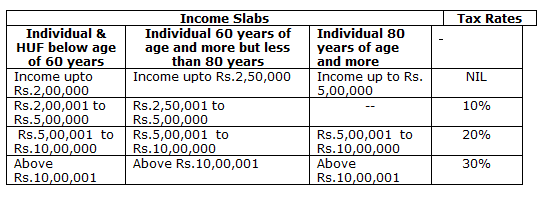
Income Tax For Financila Year 2013-2014
Image
Reply

Escape Analysis
Garbage collector
What is the interest earned on this investment ? 31,000 per year for 30 years becomes 23,10,000 .
Annuity formula is :
Maturity value = Amount paid per year * [ {(1+r)^n – 1}/r ] * (1+r)
Here n = 30 years
and r = rate of interest earned
Putting all these values
23,10,000 = 31,000 * [{(1+r)^30 -1}/r] * (1+r)
The value of r which satisfies this equation is 5.4 .
ref:http://www.jagoinvestor.com/2008/10/why-endowment-policy-are-never-best_08.html
know your maturity amount : http://licpolizy.com
Perform Logarithms in Your Head
1. When someone gives you any positive number, you should immediately ‘write’ that number in scientific notation in your head.
2. Next, focus only on the exponent of the number (written in scientific notation). This number will be the basis of you answer.
3. Estimate the logarithm of the abscissa in your head (thats the number between 1 and 9.999999…, not part of the exponent). Note: you’ll need to memorize the table below (its not that hard).
4. Add the logarithm of the abscissa to the exponent you found in step 2.
What follows are the values for the logs you’ll need to have memorized for step 3…
log(1)=0
log(2)=.3010
log(3)=.4771
log(4)=.6020
log(5)=.6990
log(6)=.7781
log(7)=.8451
log(8)=.9031
log(9)=.9542
As an example, lets find the logarithm of 29,012. Written in scientific notation, that would be 2.9012 X 10^4. So, the exponent is 4. Now, we need to concentrate on the abscissa (2.9012 is very very close to 3). From our table above (which we have memorized for the trick), the logarithm of 3 is 0.4771. So, we add the exponent (4), to the log of the abscissa (0.48), to get a value of 4.4771
 Lekshmana Perumal Murugan